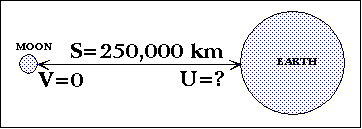
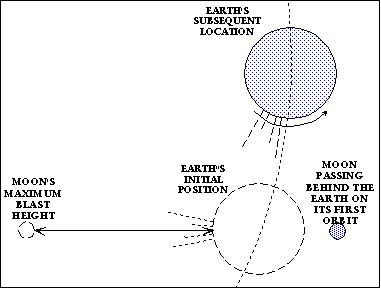
A protoplanet does not have any significant solar (axial) rotation when it condenses from an orbiting dust cloud. Axial rotation throughout the solar system is generally in the same direction as the sidereal motion which is posigrade, or anticlockwise. This strongly suggests the mechanism for initiating solar rotation is a universal phenomenon rather than a one-off impact event. This essay assumes the protoplanet (eg earth) initially had the same face pointing towards the Sun. This heated, together with a rising internal temperature (and pressure) caused by radio activity. The result was a soft spot, or zone of weakness, developed on the solar pointing face of the protoplanet. An enormous eruption followed which blasted a portion of the planet into space, as follows:
COMMON SOLAR AND SATELLITE ROTATION INITIATION
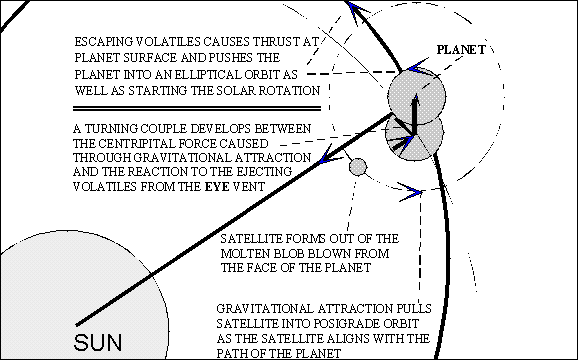
At the point of initial eruption, the gas jet force reacts on the surface of the planet as shown. Simultaneously, the sidereal orbit of the planet moves the centre of centrifugal attraction (planet's centre-of-gravity) ahead of the jet force action. This establishes a turning-couple comprising the jet stream reaction force with the centrifugal force. Turning forces cause planets to accelerate on their axis developing solar angular velocity, or axial rotation. The reaction to the jet stream force also causes the planet to move into an elliptical orbit around the sun.
Uneven, or very weak heating at the planet surface, results in an asymmetric gas-discharge from the planet. This can produce a variety of orbit directions and inclinations in both the parent planet and ejected satellites. Examples include Uranus, Triton, Nereid, Pluto and Charon.